Global shipping turns every parcel into a small engineering project. A box may face conveyor impacts, vibration, humidity, compression, and sudden temperature changes. Choosing suitable packaging supplies is therefore more than filling empty space. It is a practical risk-control decision.
This guide examines ten dependable options for international shipments. They include corrugated cartons, molded pulp inserts, foam protection, kraft paper, air pillows, stretch film, water-activated tape, tamper-evident seals, desiccant packs, and shipping labels. Each item serves a clear purpose. Some protect fragile corners. Others stabilize loads or reduce moisture exposure. The best choice depends on product weight, dimensions, route length, and handling conditions. Small details matter. A ceramic mug needs edge support, not only bubble wrap. A pallet needs secure strapping and balanced weight. In real packing rooms, teams often discover that extra protection can create wasted volume or crushing pressure. That lesson is easy to miss.
The discussion compares performance, cost, sustainability, and packing efficiency. It also considers realistic warehouse use, where speed and consistency matter. Recommendations should be checked against carrier guidance, product specifications, and destination requirements. No single material works for every shipment. Even experienced packers sometimes overlook condensation or weak tape adhesion in cold weather. Testing a sample package before large-scale dispatch is a modest step, but it can prevent expensive damage. Reliable packaging begins with evidence, not assumptions.
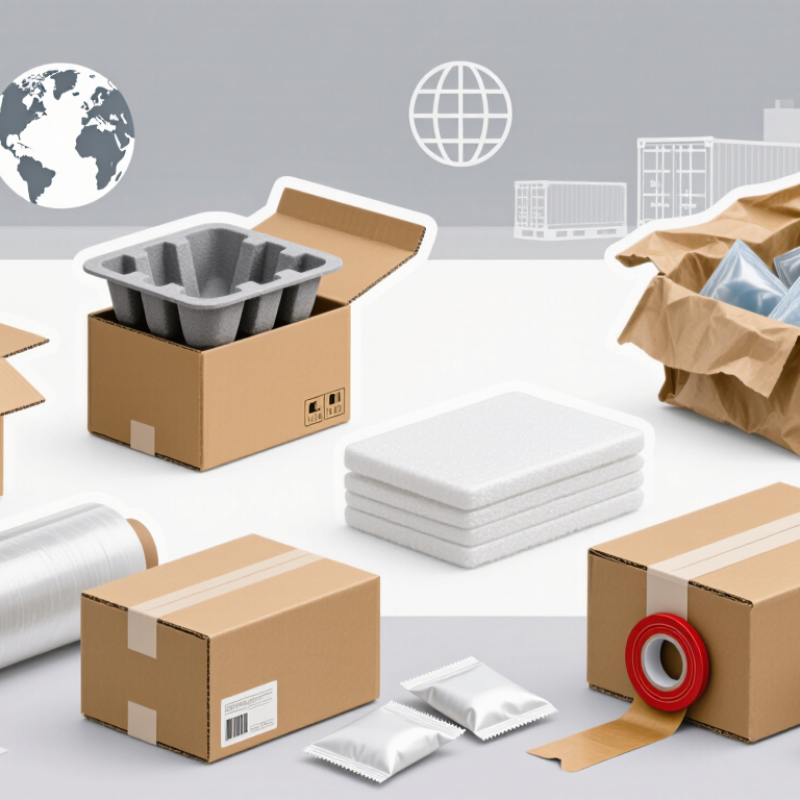
International shipping needs packaging that handles vibration, compression, moisture, and repeated loading. Corrugated boxes are the basic choice, but box strength should match the product’s weight and travel distance. Double-wall cartons offer better protection for dense or fragile goods.
Cushioning materials fill empty space and reduce movement inside the carton. Paper padding, molded fiber, foam sheets, and air cushions each suit different products. Use edge protectors for glass, ceramics, or equipment with sharp corners. Moisture-resistant bags can protect textiles and electronics during humid journeys. Strong packing tape should seal every opening, while stretch film and strapping help stabilize larger cartons on pallets. Clear handling labels also reduce avoidable mistakes.
I once saw a well-sealed parcel arrive with crushed corners. The contents survived, but the box was too large and poorly supported. That experience changed my packing checks.
I now shake test each carton gently and press its panels before dispatch. Small details matter. Pallets should stay dry, evenly loaded, and secured with corner boards. Product labels must remain readable after wrapping. I still overestimate how much cushioning is enough sometimes. Testing a sample shipment is wiser than trusting appearance. A neat package can still fail inside.

Choosing packaging materials for global shipping starts with the product, not the box. A ceramic mug needs rigid protection and cushioning around its handle. Clothing usually needs a moisture-resistant mailer with minimal empty space. Heavy tools require reinforced cartons, strong tape, and edge protection. Small electronics benefit from anti-static sleeves, cushioning, and a snug inner box. I once selected oversized packaging for a fragile item. The product arrived safely, but shipping costs rose unnecessarily.
Packaging should also match the journey. Corrugated cartons handle stacking better than thin folding boxes. Paper cushioning works for light items, while molded pulp or foam may suit delicate equipment. Moisture barriers help during humid port transfers. Use clear handling labels, accurate dimensions, and secure closures. Test filled packages with drop, vibration, and compression checks. Real conditions are rarely gentle.
Tips: Measure the product and its cushioning together. Leave no large empty spaces. Use separate inner wrapping for parts that can scratch each other. Choose packaging that workers can lift safely. Check seams after sealing. If a box feels weak, it probably is. Review failed tests honestly, even when the packaging looks attractive. Overpacking wastes material, but underpacking creates greater risk.
Typical nominal thickness of common packaging materials used for different product types
Thickness is a practical starting point when choosing packaging for international shipping. Use corrugated board and wooden crates for structural protection, cushioning materials such as bubble wrap, foam, and molded pulp for fragile goods, and thin films or air pillows for lightweight void filling. The appropriate material also depends on product weight, moisture exposure, stacking pressure, and transport conditions.
Top 10 Packaging Supplies for Safe Global Delivery
Global shipping exposes parcels to stacking, vibration, humidity, and repeated transfers. The World Bank Logistics Performance Index 2023 analyzed 4,090 assessments across 139 economies. Its findings highlight major differences in tracking, handling, and delivery reliability. Packaging must handle uncertainty, not just distance.
Use a double-wall corrugated carton for heavy products. Add paper cushioning, bubble wrap, or molded foam around fragile areas. Corner protectors reduce crushing at the edges. Reinforced water-resistant tape keeps seams closed. Stretch film helps stabilize grouped items, while desiccant packs limit moisture inside sealed cartons. A waterproof document pouch protects customs paperwork. Tamper-evident seals reveal unwanted opening. These ten supplies work best as a system. One layer rarely solves every risk. I still see parcels overpacked in the center but weak near the corners.
Tips: Leave minimal movement inside the box. Shake-test the sealed package gently. If the product shifts, add cushioning. Use the smallest suitable carton to reduce empty space and transport volume. The United Nations Environment Programme’s Global Waste Management Outlook 2024 projects municipal waste could rise from 2.3 billion tonnes in 2023 to 3.8 billion tonnes by 2050. Choose recyclable paper-based protection where performance allows. However, replacing plastic without testing can cause damage, which creates more waste. Check closure strength, moisture resistance, and drop performance before scaling shipments.
International shipping requires more than a strong box. Packaging must protect the item and support customs inspection. Use durable corrugated cartons, cushioning, moisture barriers, strong tape, and clear shipping labels. Select materials according to the item’s weight, shape, and travel conditions.
International packing standards differ by destination and transport method. Wooden pallets and crates may require heat treatment and an approved treatment mark. Check the latest import rules before dispatch. Labels should show the sender, recipient, destination country, package count, gross weight, and handling instructions. Customs descriptions must be specific and accurate. Avoid vague terms such as “parts” or “samples.” Include the correct tariff classification when required. Rules change, so old templates can mislead you.
Tips: Print labels with waterproof ink. Place one label on the top and another on the side. Remove outdated barcodes. Add an internal packing list. Photograph the sealed carton before collection. Small details help.
A practical weakness remains unavoidable. Labels can tear, and cartons can absorb moisture during storage. I recommend adding a duplicate document pouch and leaving space for inspection. Still, excessive wrapping may increase cost, weight, and waste. Test one package through your chosen carrier before shipping a large batch. Review delivery damage, label visibility, and customs questions. Then adjust the packing method.
10 Best Packaging Supplies for Global Shipping
Ways to Reduce Shipping Damage, Cost, and Environmental Impact
Reliable global shipping starts with the right packaging supplies. In fulfillment work, I have seen weak cartons fail at corners, seams, and wet loading areas. Double-wall cartons provide stronger protection for heavier products. Smaller cartons reduce empty space and dimensional shipping charges. Molded-pulp inserts hold fragile items without adding much plastic.
A practical supply set includes kraft paper, honeycomb wrap, corner protectors, and paper cushioning. These materials prevent movement and absorb shocks during repeated handling. Water-activated paper tape seals cartons firmly and supports easier recycling. For moisture-sensitive goods, a thin recyclable liner can add protection without excessive layers. Tamper-evident seals also make opening more visible during transit.
Measure the product before buying cartons. A two-centimeter gap can create costly movement. Fill empty spaces, but do not compress delicate goods. That mistake can cause pressure damage. Use clear handling instructions where appropriate, while avoiding promises packaging cannot guarantee. For international routes, check destination requirements and avoid restricted materials or unnecessary wooden components. Test packed cartons with drop, vibration, and compression checks before scaling shipments. Keep a record of failures, damage patterns, and customer feedback. The best solution may change by climate, route, and product shape. I still overpack some irregular items, because reducing material too quickly can increase breakage. Less packaging is not always lower impact. A damaged replacement shipment may create more waste, labor, and emissions.
| No. | Packaging Supply | Primary Protection | Typical Material / Specification | How It Reduces Damage | Cost and Space Advantage | Environmental Considerations | Best-Practice Use |
|---|---|---|---|---|---|---|---|
| 1 | Double-Wall Corrugated Box | Compression, stacking, puncture, and moderate impact protection | Two fluted layers with three linerboards; commonly selected by edge-crush or box-compression rating | Provides greater stacking strength than a single-wall box and helps protect products during palletized transport | Usually costs more than single-wall packaging but can reduce product loss and outer-box failure in long-distance shipping | Widely recyclable where clean corrugated fiber is accepted; recycled fiber content varies by specification and supplier | Choose a box with limited empty space and use an internal cushion so the product cannot move freely |
| 2 | Molded-Pulp Inserts | Shock absorption, separation, and product immobilization | Formed cellulose fiber, often produced from recycled paper or agricultural fiber | Creates fitted cavities that keep products away from box walls and distribute impact forces | Designed inserts can replace several loose cushioning components and reduce assembly time | Generally recyclable or compostable depending on additives, coatings, local facilities, and contamination | Use for repeated product shapes; maintain clearance between fragile surfaces and the shipping carton |
| 3 | Honeycomb Paper Cushioning | Surface protection, edge cushioning, and lightweight impact absorption | Expandable paper web with a honeycomb structure; available in different widths and basis weights | Wraps around irregular items and absorbs localized impacts without adding rigid plastic components | Ships and stores compactly before expansion, reducing warehouse volume compared with preformed foam | Paper-based options are commonly recyclable when free from plastic film, tape, and heavy contamination | Overlap layers around corners and edges; combine with a fitted carton for highly fragile products |
| 4 | Kraft Paper Void Fill | Movement prevention and light-to-moderate impact protection | Crinkled, folded, or fan-folded kraft paper in rolls or sheets | Fills gaps and limits product movement, reducing abrasion and repeated impact inside the carton | Easy to cut to order and does not require specialized recovery equipment at the packing station | Often recyclable as paper if dry and clean; using the minimum effective quantity reduces material consumption | Place paper around all sides of the product rather than only on top of the package |
| 5 | Air-Cell Cushioning | Lightweight impact and vibration protection | Inflated air chambers made from plastic film; chamber size and film thickness determine performance | Air chambers provide separation from carton walls and can cushion lightweight, non-sharp products | Very low shipping and storage volume before inflation; can reduce package weight | Plastic film recycling depends on local collection systems; reuse or deflate before disposal where appropriate | Use with products that have no sharp edges; do not rely on it alone for heavy or high-value items |
| 6 | Water-Activated Paper Tape | Carton closure, tamper visibility, and seam reinforcement | Gummed paper tape activated with water; reinforced grades contain paper-embedded fibers | Forms a strong bond with corrugated fibers and helps prevent seams from opening under handling stress | One strip can replace multiple overlapping strips of pressure-sensitive tape and supports faster carton identification | Paper tape can simplify fiber recycling when compatible with the carton and local mill requirements | Apply sufficient tape across the center seam and extend it down the sides according to carton weight |
| 7 | Edge and Corner Protectors | Compression, edge crushing, and strap damage prevention | Rigid fiberboard, molded pulp, or recycled plastic profiles | Distributes strap and stacking pressure over a larger area and protects vulnerable corners | Allows tighter pallet loads and can reduce carton deformation during multi-leg transport | Fiber versions are generally compatible with paper recycling; plastic versions may require separate recovery | Use on palletized cartons, furniture, framed goods, and products with exposed corners |
| 8 | Stretch Film | Unit-load stability, dust protection, and moisture splash resistance | Elastic polyethylene film applied by hand or machine; pre-stretch and thickness affect material use | Holds cartons together and reduces shifting, toppling, and exposure during warehouse and freight handling | Machine or pre-stretch application can use less film than loose hand wrapping while improving load consistency | Use only as much film as needed; collect clean film separately where commercial film recycling is available | Secure the load to the pallet without blocking labels, ventilation points, or required handling marks |
| 9 | Desiccant Packs | Humidity and condensation control | Moisture-absorbing materials such as silica gel, clay, or molecular sieve in porous sachets | Reduces corrosion, mold risk, odor, and moisture-related deterioration inside sealed packaging | Small and lightweight; can prevent expensive damage when goods pass through humid climates or temperature changes | Disposal requirements vary by filling material and local regulations; keep sachets sealed and follow safety instructions | Size the quantity for product volume, barrier-bag permeability, transit duration, and expected humidity |
| 10 | Moisture-Barrier Inner Packaging | Water vapor, dust, and temporary exposure protection | Sealable polyethylene or multilayer barrier bag selected for the required vapor and puncture resistance | Creates a secondary barrier that protects products if cartons encounter condensation, rain, or humid storage | Can reduce returns and rework for moisture-sensitive goods; right-sizing limits excess film use | Material choice affects recyclability; mono-material designs are generally easier to sort than multilayer structures | Use with desiccant when required, remove trapped air where practical, and seal before placing the item in the carton |