
China Top Industrial Thermal Transfer Labels Supplier?

China Top Industrial Thermal Transfer Labels Supplier? The answer requires more than a low quotation. Buyers must examine material stability, print accuracy, adhesive performance, and production traceability.

Smithers’ industry research on global printed labels highlights continued demand for durable identification, logistics automation, and variable-data printing. Its forecasts also emphasize pressure on suppliers to improve efficiency and sustainability. Grand View Research reports steady growth in the thermal transfer labels market, supported by retail, healthcare, manufacturing, and transportation applications. These figures suggest opportunity, but market reports cannot replace factory-level verification.

The details matter. A reliable Industrial Thermal Transfer Labels supplier should explain its face-stock options, adhesive grades, ribbon compatibility, and temperature limits. Product samples should survive abrasion, moisture, cold storage, and repeated scanning. A warehouse label may face dust, forklift movement, and fluctuating temperatures within one week. That is where laboratory claims meet practical experience.

Mike Fairley, a respected label-industry consultant, has often described labels as “the silent salesman.” For industrial labels, that role becomes more demanding. A faded barcode can interrupt inventory movement, while weak adhesive can detach from corrugated cartons or plastic drums. Chinese manufacturers may offer strong converting capacity, fast customization, and competitive export experience. However, not every supplier provides the same process control. ISO certification alone is not enough. Buyers should request batch records, inspection standards, test reports, and customer references.

This guide examines China’s leading suppliers through those practical criteria. It also recognizes an uncomfortable point: the cheapest label is rarely the cheapest operational choice. Supplier rankings can change as capacity, materials, and quality systems develop. Verification remains essential.
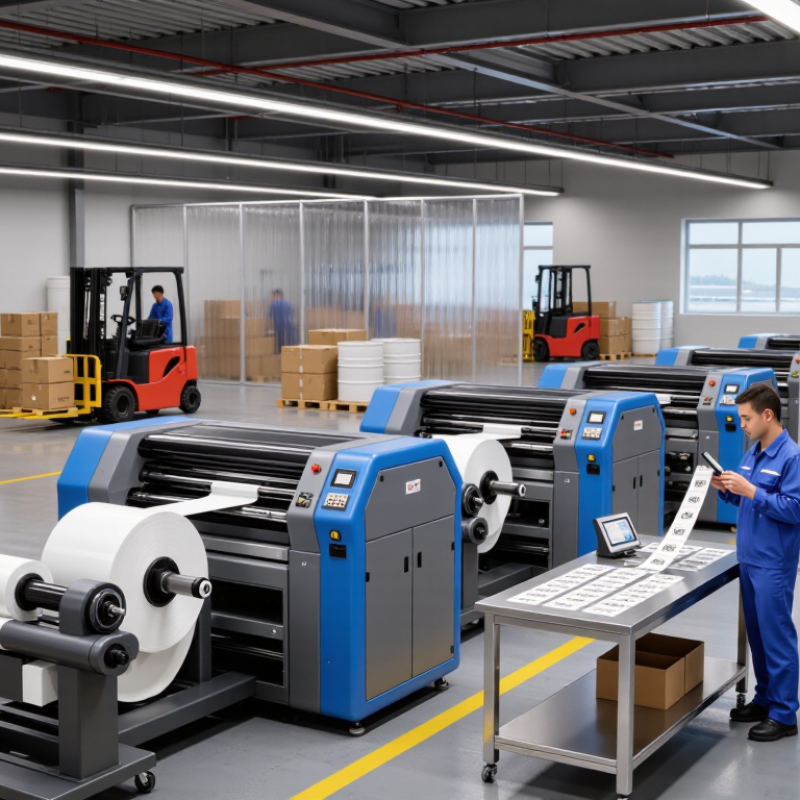
China Top Industrial Thermal Transfer Labels Supplier?

China’s Industrial Thermal Transfer Label Suppliers: Scope and Product Types

China’s Industrial Thermal Transfer Label Suppliers: Scope and Product Types

China’s industrial thermal transfer label suppliers cover more than printing. Their scope often includes face-stock selection, adhesive coating, die-cutting, ribbon matching, testing, and export documentation. MarketsandMarkets estimates the global barcode labels market could grow from about USD 11.7 billion in 2023 to USD 17.3 billion by 2028. This growth supports demand for durable identification in warehouses, factories, cables, and equipment rooms.

Common product types include paper labels for indoor cartons, polypropylene labels for moisture exposure, polyester labels for machinery, and polyimide labels for high-temperature electronics. Suppliers also produce continuous rolls, fanfold labels, pre-cut tags, asset labels, warning labels, and variable-data labels. A practical evaluation should check print contrast, adhesive aging, ribbon compatibility, and resistance to oil, abrasion, and heat. Small details matter.

Smithers’ “The Future of Global Printed Labels to 2028” identifies continued demand for efficient, data-driven label production. Yet market reports can hide factory-level variation. A supplier may show a clean sample but provide weak batch control. I would request three production samples, not one. Ask for peel-strength results, storage conditions, roll tolerance, and application temperature. That process is slower, but often more reliable. Some specifications still need revision after field testing.

Material Selection for −40°C to 150°C Industrial Labeling Environments

China Top Industrial Thermal Transfer Labels Supplier?

Material Selection for −40°C to 150°C Industrial Labeling Environments

Industrial labels must survive more than a temperature range. They face condensation, vibration, oils, solvents, and rough handling. In plant trials, polyester often performs well on painted metal and plastic housings. It resists tearing and supports sharp thermal transfer printing. For continuous exposure near 150°C, polyimide is usually a safer choice. It maintains dimensional stability when ordinary films begin to soften.

Adhesive selection deserves equal attention. A permanent acrylic adhesive can work across changing temperatures, but it needs enough time to bond. At −40°C, weak initial adhesion may cause edge lifting. Silicone adhesives tolerate higher heat and some difficult surfaces, yet they may cost more and require careful application. Clean the surface first. Dust ruins good materials.

Supplier verification should include technical data, batch traceability, and application samples. Ask for testing after thermal cycling, not only room-temperature results. We once saw a label pass a short heat test but fail after repeated cooling. That result changed our evaluation method. Ink and ribbon compatibility also matters; resin-based ribbons usually provide stronger resistance to abrasion and chemicals. Still, no material fits every enclosure, coating, or production speed. Samples should be tested on the actual surface, under actual conditions.

Choosing 203, 300, or 600 dpi Printing for Industrial Barcodes

Choosing 203, 300, or 600 dpi Printing for Industrial Barcodes

When selecting industrial thermal transfer labels, print resolution should match the barcode’s job. A 203 dpi printer suits larger labels, warehouse cartons, and simple Code 39 symbols. It prints quickly and keeps operating costs reasonable. A 300 dpi printer offers sharper edges for smaller barcodes, detailed text, and moderate scanning distances. For tiny labels, dense 2D codes, or high-resolution product identification, 600 dpi can protect readability. However, higher resolution does not automatically create better results.

Tips: Test the actual label, ribbon, and scanner together. Measure the narrowest barcode element, not only the label size. Check performance after abrasion, heat, moisture, and repeated handling. A clean 300 dpi print may outperform a poorly adjusted 600 dpi print. Small details matter.

Experienced label suppliers should review the application before recommending equipment. They may inspect conveyor speed, viewing distance, label material, ribbon type, and expected storage conditions. In practice, 203 dpi can look slightly rough on small characters, while 600 dpi may expose design flaws and demand tighter calibration. That is easy to overlook. Print darkness, label movement, and barcode spacing also influence scanning reliability. Run samples during normal production, not only in a quiet office. A few failed scans can reveal more than a specification sheet.

Wax, Wax-Resin, and Resin Ribbons: ISO/IEC 15415 Barcode Performance

China Top Industrial Thermal Transfer Labels Supplier?

Wax, wax-resin, and resin ribbons affect ISO/IEC 15415 barcode performance differently. Wax ribbons suit coated paper and standard carton labels. They provide clear images at moderate print temperatures. Wax-resin blends improve edge definition and abrasion resistance. They work well for logistics, retail, and warehouse identification. Resin ribbons offer stronger resistance against moisture, chemicals, heat, and repeated handling. They are often selected for synthetic label materials. Material matching matters more than ribbon price. A poor match can create voids, bleeding, or uneven cell edges. These defects may reduce contrast and decoding reliability.

Tips: Test the exact label and ribbon together. Adjust darkness and print speed gradually. Inspect quiet zones, finder patterns, and small cells. ISO/IEC 15415 grading should use calibrated verification equipment, not visual judgment alone. Record results across several printed batches. One scan can mislead you. Printer alignment, dust, surface texture, and storage conditions can also change performance. Keep labels dry and protected from direct heat.

In practical production, resin may seem like the safest choice, but it is not always necessary. Wax can deliver reliable results when the substrate is suitable and the barcode size is generous. Wax-resin often provides a useful balance for busy distribution environments. Still, grade targets should reflect the scanning system and application distance. A high laboratory score may not guarantee perfect field performance. That assumption deserves review. Suppliers should provide material samples, test data, and traceable quality records before volume production.

Industrial Thermal Transfer Labels: Wax, Wax-Resin, and Resin Ribbons

ISO/IEC 15415 uses letter grades to evaluate the quality of 2D barcodes. The chart maps the nominal grade points from A to F.

Wax Ribbon

Commonly used with uncoated paper labels for general-purpose printing. Barcode results depend on ink transfer, label surface, print speed, and darkness.

Wax-Resin Ribbon

Provides a balance between print economy and resistance to handling, smudging, and limited environmental exposure.

Resin Ribbon

Designed for durable printing on compatible synthetic or coated materials where abrasion, chemicals, moisture, or heat resistance is required.

Important: ISO/IEC 15415 does not assign a fixed barcode grade to a ribbon type. The verified result is influenced by the printer, substrate, print settings, barcode symbology, and inspection conditions. A barcode verifier should be used to confirm the final grade.

Evaluating Suppliers by ISO 9001, IATF 16949, MOQ, and Lead Time

Choosing a top industrial thermal transfer label supplier requires more than a low quotation. The ISO Survey 2022 recorded 1,265,216 ISO 9001 certificates worldwide. However, certification alone cannot prove label durability. Ask for the certificate scope, audit status, and corrective-action records. A reliable factory should trace adhesive, liner, ink, and coating batches. Request samples from the same production line. Small details matter.

For automotive applications, IATF 16949 deserves closer review. It emphasizes defect prevention, traceability, and supplier risk control. IATF’s public data lists tens of thousands of certified manufacturing sites globally. Verify the actual production site, not only a trading office. Test labels against heat, oil, abrasion, and humidity. A barcode that scans today may fail after three months. That test is uncomfortable, but useful.

MOQ and lead time reveal operational maturity. Compare standard MOQ, custom MOQ, setup charges, proof approval, and replenishment capacity. The 2024 MHI Annual Industry Report shows that supply-chain leaders continue increasing investment in digital visibility and resilience. Ask for a written lead-time range, not “fast delivery.” Separate artwork approval, tooling, production, inspection, and export transit. A practical supplier may offer a 10,000-piece pilot order and 7–15 working-day repeat production, but these figures require verification. I would also check peak-season capacity. Few buyers do. That is a mistake.

China Top Industrial Thermal Transfer Labels Supplier? - Evaluating Suppliers by ISO 9001, IATF 16949, MOQ, and Lead Time

Evaluation Dimension Recommended Evidence Preferred Benchmark Why It Matters Procurement Decision
ISO 9001 Quality Management Current certificate issued by an accredited certification body; defined procedures for incoming inspection, in-process control, and final inspection. Valid certification Confirms that quality processes are documented and monitored. Required
IATF 16949 Capability Valid IATF 16949 certificate or documented automotive-grade controls, including traceability, risk analysis, corrective action, and process capability records. Preferred for automotive programs Supports stricter automotive requirements and supplier-audit expectations. Conditional
Minimum Order Quantity Written MOQ by label size, material, adhesive, color, core size, and printing configuration. 5,000–20,000 labels per SKU Lower MOQ reduces inventory exposure during qualification and product launch. Favorable
Standard Production Lead Time Confirmed production schedule covering artwork approval, material preparation, printing, converting, inspection, and packing. 7–15 working days Enables reliable production planning and replenishment. Favorable
Custom or Complex Lead Time Lead-time commitment for specialty face stocks, aggressive adhesives, variable data, multi-color printing, or custom die cutting. 15–30 working days Highlights scheduling risks before purchase orders are released. Verify
Thermal Transfer Compatibility Documented compatibility with wax, resin, and wax-resin ribbons; print samples tested on the buyer’s printer and substrate. Passes application testing Prevents poor print quality, smearing, fading, and barcode failure. Required
Material and Adhesive Selection Technical data sheets for polyester, polypropylene, polyimide, coated paper, and permanent or removable adhesive options. Application-specific recommendation Ensures performance under heat, abrasion, chemicals, moisture, and outdoor exposure. Required
Barcode and Variable-Data Quality Barcode verification records, print contrast testing, winding consistency, and lot-level inspection results. Readable on first scan Reduces scanning errors in manufacturing, warehousing, and distribution. Required
Quality Traceability Lot number, raw-material records, production date, inspection report, and retained samples linked to each shipment. Full batch traceability Supports root-cause analysis, recalls, and corrective actions. Required
Sample and Pre-Production Approval Free or paid samples, adhesive testing, printer trials, artwork approval, and signed golden samples before mass production. 5–10 working days for samples Reduces the risk of large-volume nonconformity. Preferred
Recommended qualification rule: Prioritize suppliers with valid ISO 9001 certification, IATF 16949 capability where automotive compliance is required, an MOQ within the project’s forecast, and a documented lead-time commitment supported by sample approval and batch traceability.