Why Are Clear Bags So Popular for Events?
A clear bag can make a crowded entrance feel less complicated. Staff can see its contents without asking visitors to unpack every item, while attendees can find a phone, ticket, or water bottle at a glance. That practical mix of visibility and convenience helps explain why clear bags appear at concerts, sports venues, and festivals. But the appeal is not only about entry. A transparent tote also keeps essentials visible under dim arena lights, though it offers less privacy than an opaque bag.
Event-industry research provides useful context. Freeman’s 2024 Trends Report examines attendee and organizer expectations, including the value people place on in-person experiences. It does not measure clear-bag demand directly, so it would be misleading to claim that its findings prove why these bags are popular. Still, smoother entry can support a better event experience. Venue bag policies and size limits vary, so visitors should check the event’s official guidance before packing. A small, structured clear bag is often easier to carry through a queue than a floppy tote filled with loose items. Details matter.
There is a trade-off. Transparency can speed visual checks, but it also exposes personal belongings and may not suit every attendee. Clear bags are not automatically more comfortable, either; stiff plastic can press against the shoulder during a long day. Their popularity seems to come from a simple balance: visible contents, easy access, and fewer surprises at the entrance. Not perfect. Just practical.
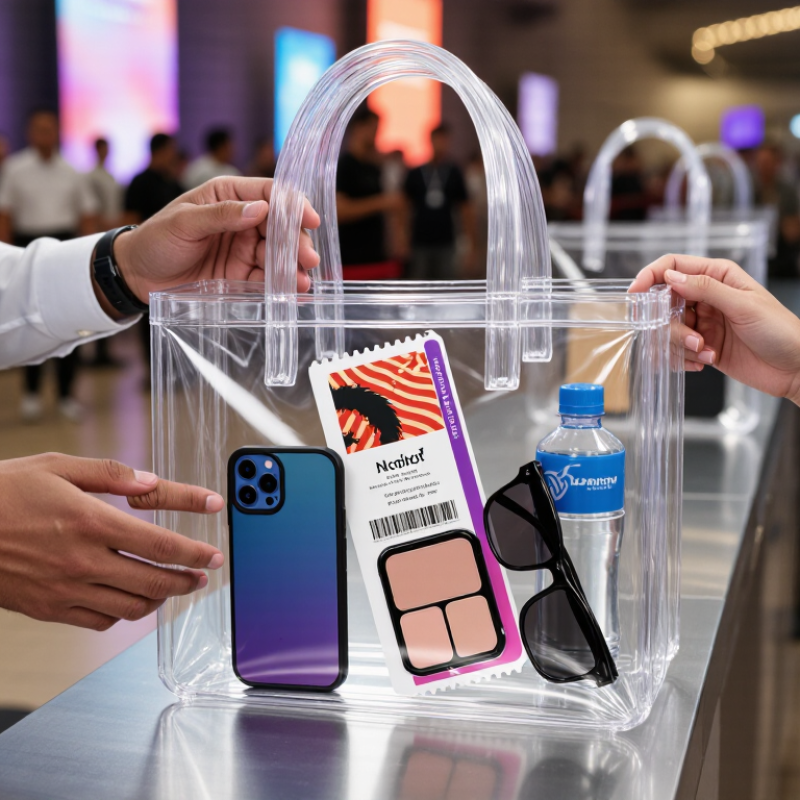
A clear bag is made from transparent plastic, vinyl, or a similar material. Its purpose is simple: let staff see the bag’s contents without opening it. Light passes through the material, while seams, folds, glare, and printed designs can still obscure small objects. ASTM International’s D1003 test method measures light transmission and haze in transparent plastics; it helps describe visibility, not guarantee a bag is easy to inspect in every setting. Not magic.
Venue rules turn that basic design into practical specifications. Published stadium-entry policies commonly allow a clear bag up to 12 × 6 × 12 inches or a clear one-gallon bag. These figures give visitors a measurable limit and help staff assess bags more consistently. A clear panel alone may not be enough: opaque fabric, deep pockets, or heavy decoration can block the view. Under bright entry lights, even a transparent bag can catch glare. Small details matter.
In use, the bag works as a visible container, not a security device. Staff can check its contents from outside, which may reduce the need for hands-on searches and keep entry moving. The trade-off is privacy: personal items are easier for others to see. And transparency has limits. I’d be cautious about assuming every clear bag is equally readable; scuffs and cloudy plastic can make a real difference.
Clear bags are popular at events because they make a quick visual check possible before a guest reaches the ticket scanner. A staff member can see a folded jacket, a phone, or a water bottle without asking someone to unpack everything. Visibility helps. It does not replace trained screening or venue-specific rules. Bag dimensions and exceptions differ, so clear instructions at the entrance matter as much as the bag itself.
That figure covers airport screening, not event venues, and it does not prove that clear bags alone reduce waiting times. It does show the scale of screening operations and the need for practical procedures. At an event, clear materials can help staff spot contents earlier and direct a bag for closer inspection when needed. They can also create small delays when glare, crowded queues, or unfamiliar bag shapes make contents harder to judge. Clear bags are useful, but not foolproof. Staff still need consistent training, accessible screening lanes, and signage that explains size limits before guests join the queue.
Clear bags are popular at events because they make routine checks easier for attendees and organizers. At a crowded entrance, staff can inspect visible contents without asking guests to unpack everything. That may help lines move more smoothly, though staffing and venue procedures still matter. Attendees can spot a phone, ticket, or sunscreen quickly instead of digging through a dark tote.
For organizers, consistent bag rules can make entry instructions easier to communicate. For guests, a lightweight transparent bag keeps essentials close and can be simple to carry between stages or seating areas. Still, clear does not always mean convenient. Some people feel exposed when personal items are visible, and confusing size limits can cause frustration at the gate. A policy that works well at one venue may not fit another, so organizers should publish exact dimensions and check procedures before event day.
Tips: Check the venue’s current bag rules before leaving home. Choose a bag with a secure closure and enough room for essentials, not every “just in case” item. Keep medication or other sensitive belongings discreet where venue rules allow. A small pouch inside can help, but it may also slow inspection.
Clear event bags are made from several materials, and each feels different in use. PVC is firm and often keeps its shape, while flexible EVA can feel softer in the hand. TPU is another option, valued for flexibility and resistance to cracking, though performance varies with thickness and construction. Some bags use clear mesh panels, which reduce weight but offer little protection from rain. Small details matter. A zipper that catches or a cloudy panel can make a bag frustrating, even when its shape looks polished.
Styles range from compact crossbody pouches to transparent totes and backpacks. Wide straps help distribute weight, while a short handle suits quick entry and a few essentials. Design options include tinted panels, colored edging, reinforced corners, inner pockets, and adjustable straps. Keep decoration modest if visibility is the main goal. A pale tint may look subtle indoors but reduce clarity in dim lighting. In everyday use, seams deserve attention too; weak stitching can split at the corners. Check the bag’s dimensions against the event’s stated requirements before buying, since accepted sizes can differ. That check is easy to skip.
| Dimension | Common Options | Practical Benefits | Design or Use Considerations |
|---|---|---|---|
| Why they are popular | Transparent bags make contents easier to see at a glance. | They can simplify visual checks at entrances and help visitors find items without opening the bag. | Entry procedures differ by venue and event; a clear bag does not automatically guarantee admission. |
| PVC (vinyl) | Clear, flexible PVC panels are commonly used for totes, crossbody bags, and small pouches. | Offers visibility and can be wiped clean with a damp cloth. | Check thickness, seams, and closure quality. PVC flexibility and feel vary by construction. |
| TPU | Transparent TPU is used in some bags and clear panels. | Can provide a flexible, transparent alternative to PVC. | Appearance, flexibility, and durability depend on the material specification and manufacturing. |
| EVA | Clear or translucent EVA is used in some lightweight pouches and bags. | Its flexible construction suits simple, lightweight designs. | Transparency and stiffness can vary; check the product details before choosing a style. |
| Clear tote | Open-top or zip-top bag with two handles. | Provides a wide opening and room for everyday event essentials. | Handle attachment and closure type affect carrying comfort and security. |
| Crossbody or shoulder bag | Compact clear bag with a shoulder strap, sometimes adjustable. | Keeps hands free while making belongings visible. | Strap length and hardware placement influence comfort; confirm the bag’s dimensions against venue rules. |
| Drawstring bag | Clear body with cords that serve as both closure and shoulder straps. | Lightweight and easy to open and close. | Some events restrict certain bag styles or materials, so check the event’s current policy. |
| Clutch or small pouch | Compact handheld style, often with a zipper or flap. | Useful for carrying a limited set of essentials. | Small size does not necessarily mean it is exempt from venue requirements. |
| Closures and pockets | Zippers, snaps, hook-and-loop fasteners, and clear or opaque pockets. | Closures help keep items contained; pockets can separate small belongings. | Opaque sections may be subject to venue restrictions. Choose pocket placement that does not obscure the main clear panel. |
| Colors and trim | Colored handles, edging, straps, zippers, and stitching paired with a clear body. | Adds visual contrast while retaining visibility through the main panel. | Keep important contents visible and check whether the event requires the entire bag to be transparent. |
| Size and capacity | Small pouches, compact shoulder bags, and larger totes. | Different sizes suit different event needs and personal carry preferences. | There is no single size rule for every event. Check the organizer’s stated dimensions and permitted bag types before arrival. |
Planning tip: Event bag policies can vary by venue, event, and date. Confirm the current rules—including permitted dimensions, materials, and styles—before selecting or bringing a bag.
Clear bags are popular at events because they make belongings easy to see and can speed up entry checks. Choosing one takes more thought than picking the clearest option. Start with the event’s actual requirements: some venues specify dimensions, permitted materials, or how many bags each guest may carry. Check the organizer’s current guidance before buying. A bag that looks suitable online may be too wide for a seat or too small for a phone, wallet, and sunscreen.
Consider the material, closure, and carrying style. Thicker PVC or TPU usually holds its shape better than thin film, but it may feel heavier and less flexible. A secure zipper helps prevent small items from slipping out; a snap may be quicker to open. Look for reinforced seams and straps, especially if guests will carry water bottles. Clarity can also fade from scratches, and condensation may obscure items on a humid day. Small details matter. I would not assume every clear bag is comfortable for hours.
Tips: Measure a packed sample, not just the empty bag. Test the closure, strap length, and weight with the items guests will actually bring. Avoid sharp corners inside; they can strain seams. A simple, wipe-clean surface is useful after outdoor events.
A clear-bag policy can make visual bag checks easier. This chart compares the face area of two bag sizes allowed under one published event policy.
How to read it: Face area is calculated from the listed width × height: a clear bag measuring 12 × 6 inches has a 72-square-inch face area, while a 4.5 × 6.5-inch small clutch has a 29.25-square-inch face area. Event rules vary, so check the venue’s current policy before attending.